
An Engineer’s Guide to Joint Design: 10 Essential Principles for Better Joint Design
Adhesives are sometimes treated as little more than a convenient alternative to bolts, rivets or welding.
In high-performance engineering, that is a serious underestimate of what adhesive bonding can achieve.
Structural adhesive bonding is widely used across motorsport, aerospace, automotive, composite engineering and specialist product development. Correctly engineered, a bonded joint can distribute loads over a large area, join dissimilar materials, reduce component weight and avoid many of the problems associated with welding or mechanical fasteners.
But there is an important distinction:
Choosing an adhesive is not the same as designing an adhesive joint.
The adhesive itself is only one part of the engineering problem.
Joint geometry, bond-line thickness, surface preparation, load direction, temperature, materials, manufacturing process and environmental conditions can all determine whether a bonded assembly performs successfully.
At Plan D Design, our experience with structural bonding comes from decades of engineering across Formula 1, motorsport, automotive, aerospace and specialist engineering applications.
This article provides an introduction to some of the principles engineers should consider when designing structural adhesive joints — and a useful research guide for engineering students wanting to understand the subject in greater depth.
Why Use Structural Adhesive Bonding?
Traditional engineering gives us numerous methods for joining components.
We can bolt them together, rivet them, weld them, braze them or manufacture the assembly as a single component.
Adhesive bonding provides another option, and in the right application it can offer significant advantages.
A structural adhesive joint can:
- distribute loads over a relatively large area;
- eliminate or reduce stress concentrations associated with fasteners;
- join dissimilar materials;
- avoid welding heat and distortion;
- avoid heat-affected zones;
- provide sealing as well as structural attachment;
- reduce component count and weight;
- join thin materials that may be difficult to weld;
- provide smooth aerodynamic or cosmetic surfaces;
- electrically isolate dissimilar materials where the joint is designed appropriately.
These advantages become particularly valuable in lightweight structures and composite engineering.
Carbon-fibre components, for example, cannot simply be welded together. Bonding therefore becomes one of the fundamental methods available to the designer.
Plan D’s Composite Design Services include the design and development of structural carbon-fibre components, tooling and complex composite assemblies for motorsport, automotive, aerospace, defence and industrial applications.
Structural Adhesives Aren’t Just for Carbon Fibre
Adhesive engineering covers considerably more than composite structures.
Many engineers will first encounter products such as Loctite as thread-locking compounds. But anaerobic adhesives can also be used for retaining bearings, bushes and cylindrical components, sealing flanges and creating structural or semi-structural assemblies.
One example from my own engineering career involved the manufacture of a damper shaft.
Rather than manufacture the entire component from a single piece or weld the assembly, the shaft was produced from a metal tube with a separate threaded end.
The components were designed with an appropriate interface and bonded using a high-strength retaining compound.
The result was a simple and effective assembly without introducing the heat and distortion associated with welding.
But the success of the solution didn’t simply come from choosing a strong adhesive.
The joint geometry, fit, materials, surface condition, loading and assembly process all had to be considered.
That same principle applies to almost every successful bonded structure.
Types of Structural Adhesive
There is no single material called “structural adhesive”.
Engineers can choose from numerous adhesive chemistries, including:
- epoxy adhesives;
- acrylic and methacrylate adhesives;
- polyurethane adhesives;
- cyanoacrylates;
- anaerobic retaining compounds;
- specialist high-temperature adhesive systems.
Even within one family, properties can vary significantly.
Two structural epoxy adhesives may have completely different characteristics in terms of stiffness, toughness, viscosity, working time, cure temperature and environmental resistance.
Products from manufacturers such as 3M Scotch-Weld, Huntsman Araldite and Henkel Loctite therefore comprise extensive ranges rather than one universal adhesive.
Selection should be based on the complete application.
Adhesive Strength Is Only Part of the Specification
It can be tempting to look at a manufacturer’s technical data sheet, find the highest quoted strength and assume that represents the best adhesive.
Engineering rarely works that simply.
The designer may need to consider:
- lap shear strength;
- peel strength;
- stiffness;
- toughness;
- fatigue performance;
- impact resistance;
- viscosity;
- working life;
- fixture time;
- cure temperature;
- service temperature;
- moisture resistance;
- chemical resistance;
- substrate compatibility;
- recommended bond-line thickness.
The strongest adhesive under one laboratory test condition isn’t necessarily the best adhesive for a real component.
Understanding the application’s loading and environment is therefore essential.
Bond-Line Thickness: Why the Bond Gap Matters
One of the most important concepts in structural adhesive bonding is bond-line thickness.
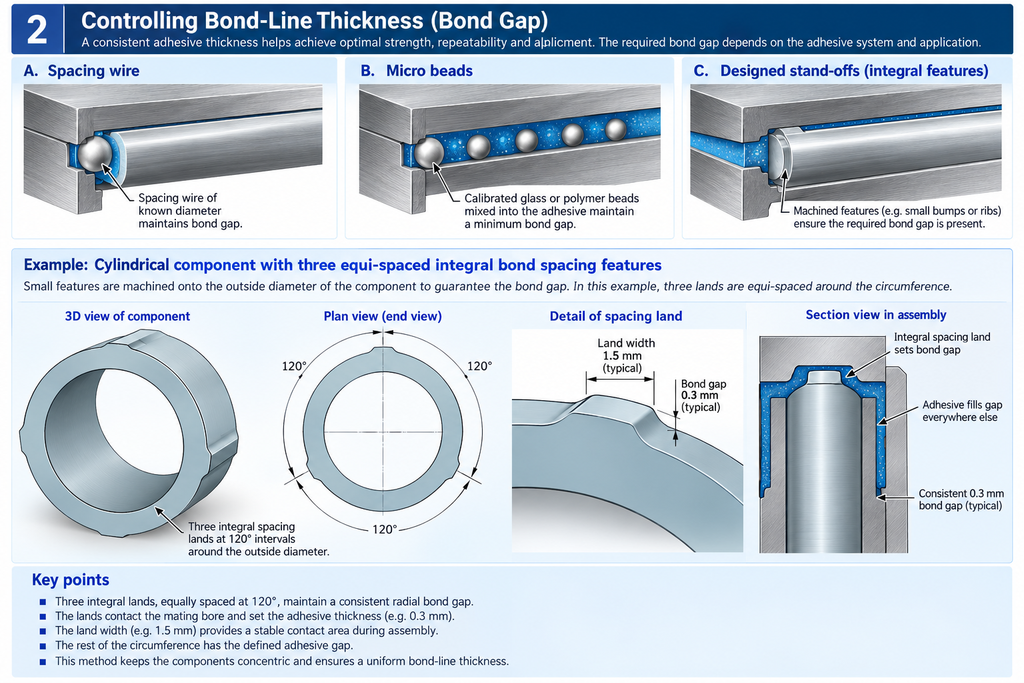
It is easy to assume that clamping two components together as tightly as possible must produce the strongest joint.
That isn’t necessarily true.
Structural adhesives are generally designed to operate within an appropriate bond-line thickness range.
If excessive clamping pressure squeezes most of the adhesive out of the joint, the resulting bond may not perform as intended.
At the other extreme, using adhesive to fill a large and uncontrolled gap can also create problems.
The engineering question therefore becomes:
How do we control the bond gap?
Several methods can be used.
Designed Stand-Offs
Small geometric features can be incorporated into one of the components so that the mating surfaces physically cannot close beyond the required distance.
This makes bond-gap control part of the component design.
Bonding Wire
Wire of a known diameter can be positioned within the joint to maintain a minimum separation between the surfaces.
Spacer Beads
Calibrated glass beads or other controlled spacer particles can be incorporated into some bonding processes to maintain a specified minimum bond line.
Whichever approach is selected, the underlying principle is important:
Bond-line thickness should be controlled by the engineering and manufacturing process rather than left to chance during assembly.
Shear vs Peel: How Adhesive Joints Like to Be Loaded
One of the most useful concepts for an engineer learning about adhesives is the difference between shear loading and peel loading.
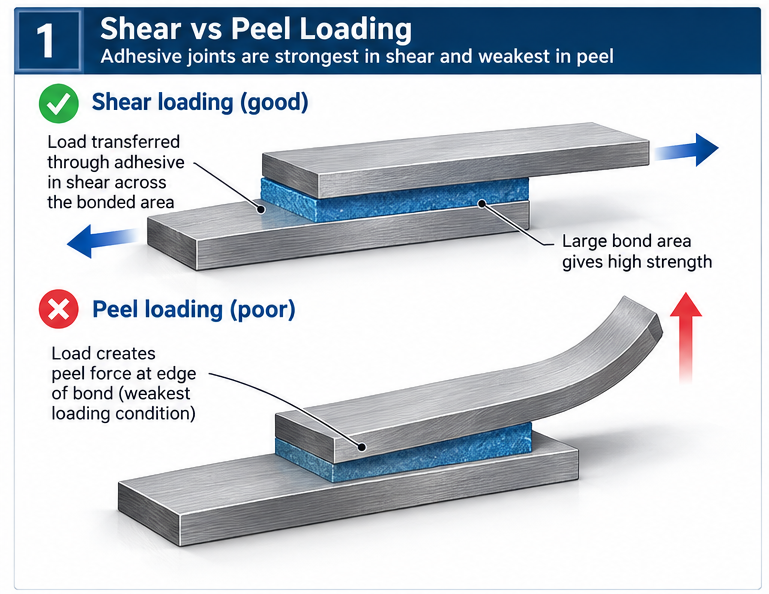
A well-designed bonded joint can transfer significant loads when a large bond area is loaded predominantly in shear.
Peel loading is a different matter.
If the geometry allows one edge of the joint to begin lifting away from the other component, load can become concentrated along a relatively small region of the bond.
Instead of asking only:
“Is the adhesive strong enough?”
the designer should ask:
“How does the load enter, travel through and leave the joint?”
That question leads directly into adhesive joint geometry.
Adhesive Joint Geometry
There are many possible configurations for bonded joints.
Useful joint types for engineering students to investigate include:
- single-lap joints;
- double-lap joints;
- scarf joints;
- stepped joints;
- bonded inserts;
- tubular joints;
- bonded sandwich structures.
Each geometry changes how load is transferred through the adhesive and substrates.
A good bonded-joint design attempts to distribute load effectively and minimise severe local stress concentrations.
This is where detailed engineering design and, for more complex applications, FEA and engineering analysis can become valuable.
Designing Against Peel Failure
If peel loading represents a potential weakness, the designer can often modify the surrounding geometry rather than simply specifying a stronger adhesive.
This might involve:
- extending the bonded area;
- changing joint geometry;
- introducing an adhesive fillet;
- modifying local stiffness;
- changing how load enters the structure;
- introducing an anti-peel feature;
- incorporating secondary mechanical retention.
In motorsport and aerospace structures, you may therefore encounter apparently small design features whose purpose is not primarily to carry the normal operating load.
Their function may instead be to prevent an edge of a bonded joint beginning to peel.
That illustrates an important principle of good engineering:
Understanding the failure mode can be more valuable than simply increasing strength.
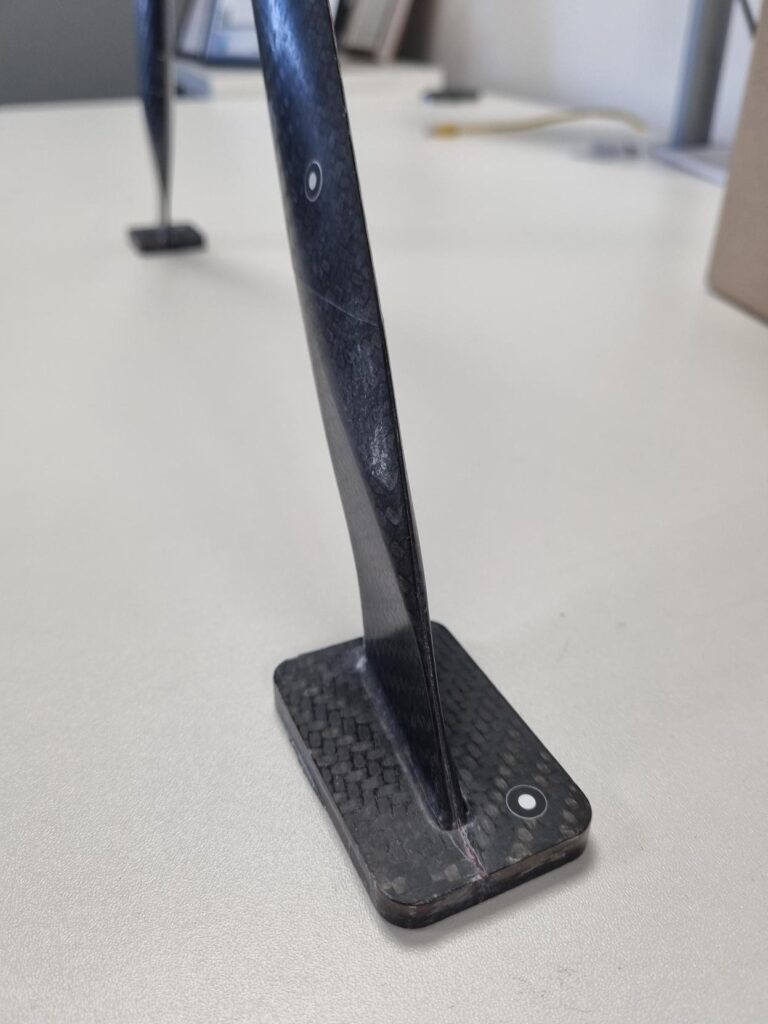
Formula 1 example: Bonding isn’t theoretical for us. One example from our F1 experience involved titanium flexures bonded into carbon-fibre suspension wishbones. We discuss the evolution of that design in our F1 Tech Tales: The Carbon Flexure article.
Adhesive Fillets and Edge Stresses
The ends of bonded joints deserve particular attention because abrupt changes in stiffness can create locally high stresses.
An adhesive fillet can sometimes help create a more gradual transition between the bonded components and alter the stress distribution around the edge of the joint.
But, as with most aspects of adhesive design, this needs to be considered as part of the complete joint rather than treated as a universal rule.
Material stiffness, geometry, adhesive properties and loading all interact.
Surface Preparation
An excellent structural adhesive applied to a badly prepared surface can produce a poor joint.
Surface preparation is therefore fundamental to adhesive bonding.
Depending on the substrate and application, preparation may involve:
- cleaning;
- degreasing;
- abrasion;
- controlled mechanical preparation;
- primers;
- chemical surface treatment;
- plasma or other specialist treatment;
- peel-ply preparation of composite surfaces.
Contamination from oils, release agents, inappropriate solvents, dust or even handling can affect bond performance.
This is particularly important with composite components.
Peel Ply and Composite Bonding
Composite manufacturing provides the opportunity to prepare surfaces specifically for subsequent bonding operations.
Peel ply is one method frequently associated with this process.
A suitable peel-ply layer is incorporated during manufacture and subsequently removed to expose a surface intended for further preparation and bonding.
The exact process needs to be compatible with the resin system, adhesive and manufacturing specification, but it demonstrates an important principle:
Bonding should be considered when the components are designed and manufactured — not only when somebody reaches the assembly stage.
This philosophy forms part of the wider design-for-manufacture approach used in our Engineering Design services.
Bonding Carbon Fibre to Metals
Joining carbon fibre to metals creates additional considerations.
Carbon fibre is electrically conductive, and direct contact with certain metals in the presence of an electrolyte can create conditions for galvanic corrosion.
Aluminium-to-carbon assemblies deserve particular consideration.
The designer may therefore need to consider electrical isolation, protective coatings, material selection, adhesive coverage and environmental sealing.
The adhesive can form part of that isolation strategy, but the complete assembly needs to be considered.
Differential Thermal Expansion
Dissimilar materials can also expand at different rates when temperature changes.
Consider an assembly containing aluminium and carbon-fibre composite.
Their thermal expansion behaviour can be significantly different.
As the assembly heats and cools, differential movement between the materials can place additional loads into the adhesive joint even when no external mechanical load is being applied.
The operating temperature range therefore forms part of the structural design problem.
Manufacturing the Bonded Assembly
Designing the joint is only part of the process.
Someone eventually has to manufacture it repeatedly and reliably.
That raises another set of engineering questions.
How will the adhesive be measured and mixed?
How will the correct mix ratio be maintained?
Will a twin-cartridge dispensing system be used?
Will a static mixing nozzle be required?
How will adhesive coverage be checked?
How will the components be located relative to one another?
How will the bond gap be maintained?
How will the components be clamped?
How much working time is available?
When can the fixture be removed?
Does the adhesive require elevated-temperature curing?
How will ambient temperature affect the cure?
What inspection or process records are required?
What initially appeared to be a simple adhesive joint has now become a controlled manufacturing process.
That is exactly what it should be.
Understanding Adhesive Failure Modes
Failure analysis is another valuable part of understanding bonded structures.
Three broad failure descriptions are particularly useful.
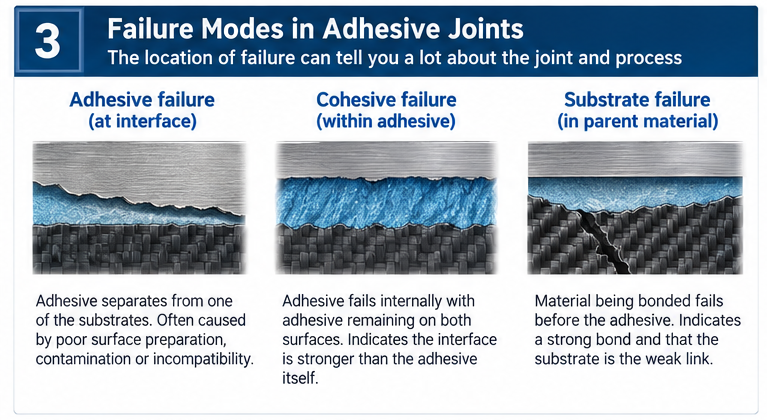
Adhesive Failure
The adhesive separates from the substrate interface.
This can indicate problems involving adhesion, surface preparation, contamination, material compatibility or the loading of the joint.
Cohesive Failure
The adhesive itself fails internally while adhesive remains attached to the substrates.
The interface has therefore behaved differently from a joint where the adhesive simply separates cleanly from the surface.
Substrate Failure
The material being bonded fails before the adhesive joint.
With composite structures, for example, failure may occur within the laminate rather than within the adhesive.
Examining how a joint failed can therefore reveal considerably more than simply recording the load at which failure occurred.
Structural Adhesives and Product Development
Adhesive bonding shouldn’t be considered in isolation from the rest of a product.
The optimum joining method depends upon the complete design, including materials, loads, production quantity, assembly method, service environment, inspection requirements and cost.
Sometimes adhesive bonding will be the best solution.
Sometimes welding, mechanical fastening or manufacturing the components differently will be better.
Sometimes a hybrid joint combining adhesive bonding with mechanical retention will make sense.
That is why joining methods should be considered as part of the wider product design and development process, rather than selected after the product has already been designed.
What Should Engineering Students Learn About Adhesives?
For students interested in Formula 1, motorsport, aerospace, automotive engineering or composite structures, adhesive technology is a surprisingly valuable subject to explore.
A useful research checklist would include:
Adhesive chemistry
- Epoxies
- Acrylics and methacrylates
- Polyurethanes
- Cyanoacrylates
- Anaerobic adhesives
Joint design
- Single and double-lap joints
- Scarf joints
- Bonded inserts
- Shear loading
- Peel and cleavage loading
- Load paths
- Edge stresses
Bond-line engineering
- Bond-line thickness
- Stand-offs
- Bonding wire
- Spacer beads
- Adhesive fillets
Surface engineering
- Cleaning and degreasing
- Abrasion
- Primers
- Peel ply
- Surface treatments
- Contamination control
Manufacturing
- Mix ratios
- Dual-cartridge systems
- Static mixing nozzles
- Working life
- Fixture time
- Clamping
- Cure schedules
- Process control
Structural considerations
- Anti-peel features
- Secondary mechanical retention
- Differential stiffness
- Thermal expansion
- Fatigue
- Vibration
Environmental considerations
- Temperature
- Moisture
- Oils and fuels
- Chemicals
- Corrosion
- Ageing
Failure analysis
- Adhesive failure
- Cohesive failure
- Substrate failure
One of the best places to continue learning is through manufacturers’ technical data sheets.
Don’t simply look at the headline strength figure.
Try to understand what was tested, how it was tested, the substrate involved, the bond-line thickness, cure conditions, temperature and type of loading.
Learning to interrogate technical data rather than simply reading the biggest number on the page is a useful engineering skill in itself.
Adhesive Bonding Is an Engineering Problem
One of the fascinating things about engineering is how apparently simple subjects become much more complex when you begin asking the right questions.
Adhesive bonding is an excellent example.
The adhesive itself matters.
But so does the geometry.
So does the substrate.
So does the surface.
So does the bond gap.
So does the load path.
So does the manufacturing process.
And so does the environment in which the component spends its life.
Structural adhesives allow engineers to create lightweight and elegant assemblies that would be difficult, heavy or expensive to manufacture using conventional joining methods.
They are particularly important in carbon-fibre and other composite structures, but their applications extend throughout mechanical engineering.
The key lesson is simple:
Don’t just choose the glue. Engineer the joint.
Need Help With a Composite or Bonded Structure?
Plan D Design provides engineering design and product-development support across motorsport, automotive, aerospace, defence and industrial applications.
Our experience includes structural carbon-fibre components, composite tooling, lightweight structures, mechanical design, analysis, prototyping and specialist manufacturing.
If you’re developing a component or product involving composites, bonded assemblies, lightweight structures or an unusual engineering problem, we can support the project from initial concept and engineering analysis through to detailed design, prototype and manufacture.
Explore our Composite Design Services
Learn more about Plan D’s Product Design & Development
Useful External Links
The best one I’ve found is 3M’s Joint Design for Structural Adhesives technical bulletin. It specifically covers designing joints so loads are shared across the bonded area, minimising peel and cleavage and controlling joint thickness. 3M Multimedia
3M – Joint Design for Structural Adhesives technical bulletin
3M also has a structural-adhesive technical resource library containing guidance on adhesive selection, joint design, performance and curing. 3M
3M Structural Adhesives Resources
Henkel’s structural bonding material is another useful reference, particularly because we’re mentioning Loctite. Henkel emphasises uniform stress distribution, durability and weight reduction as advantages of structural bonding. Henkel Adhesives