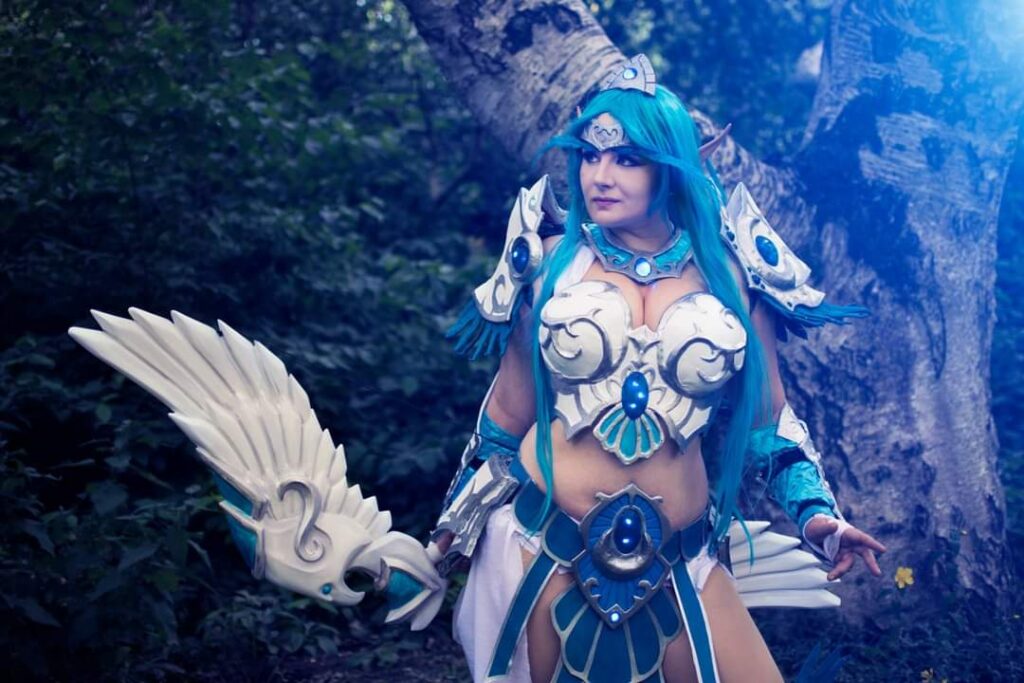
Large-scale 3D printing has transformed far more than industrial engineering and product development. It is also opening up new possibilities across the creative industries, where ambitious ideas often need to become large, physical objects quickly and economically.
From film props and cosplay to experiential marketing, exhibition displays and promotional installations, additive manufacturing allows complex digital designs to be transformed into physical objects without the tooling requirements associated with many conventional manufacturing processes.
As larger-format 3D printing systems have become available, the size of components that can be produced has increased significantly. Large props, costume elements and display pieces can either be printed as individual components or divided intelligently into sections for manufacture and subsequent assembly.
“Creativity becomes limitless when imagination can be turned into reality layer by layer.”
Why Use Large-Scale 3D Printing?
Traditional fabrication remains the right solution for many projects, but large-scale additive manufacturing offers some particular advantages where geometry is complex, quantities are low or designs are unique.
A component can be developed digitally and manufactured directly from 3D CAD data, reducing the requirement for moulds, patterns and dedicated tooling. Complex organic surfaces, internal structures and intricate details can also be incorporated without necessarily creating the manufacturing difficulties they would present using conventional processes.
For large visual components, weight can be another important consideration. Appropriate design and internal structures can allow physically impressive parts to be produced without making them unnecessarily heavy.
Perhaps most importantly, the digital manufacturing process provides considerable design freedom. A concept can be developed, reviewed and modified in CAD before committing to manufacture, while the same digital data can subsequently be used to reproduce additional components if required.
Large-Scale 3D Printing for Film Props
Additive manufacturing is particularly well suited to film, television and theatrical applications, where production teams frequently require unusual components in very small quantities.
Complex props, set pieces and costume components can be developed digitally and manufactured without investing in conventional production tooling.
3D printing can also provide a practical route for producing different versions of a component. A detailed piece may be required for close-up use, for example, while an alternative lightweight version could be developed for performance or stunt applications.
Why Use Large-Scale 3D Printing?
Traditional fabrication remains the right solution for many projects, but large-scale additive manufacturing offers some particular advantages where geometry is complex, quantities are low or designs are unique.
A component can be developed digitally and manufactured directly from 3D CAD data, reducing the requirement for moulds, patterns and dedicated tooling. Complex organic surfaces, internal structures and intricate details can also be incorporated without necessarily creating the manufacturing difficulties they would present using conventional processes.
For large visual components, weight can be another important consideration. Appropriate design and internal structures can allow physically impressive parts to be produced without making them unnecessarily heavy.
Perhaps most importantly, the digital manufacturing process provides considerable design freedom. A concept can be developed, reviewed and modified in CAD before committing to manufacture, while the same digital data can subsequently be used to reproduce additional components if required.

Large-Scale 3D Printing for Marketing & PR
The same technology has considerable potential beyond entertainment.
Marketing agencies, exhibition designers and brands frequently need physical objects that are deliberately unusual: oversized products, promotional props, exhibition features, replicas, display pieces or components for experiential installations.
These are often required in quantities of one or only a handful, which can make conventional tooling difficult to justify.
Large-scale 3D printing provides an alternative route from digital concept to physical display. Designs can be customised for a particular campaign, event or location and subsequently modified or reproduced from the original digital data.
For businesses looking to create something that attracts attention at an exhibition, product launch, promotional event or PR campaign, additive manufacturing can therefore provide a useful combination of scale, customisation and design freedom.
From Digital Design to Finished Prop
Producing a successful large-format print involves more than simply scaling up a small 3D model.
The design needs to take account of the manufacturing process, including print orientation, wall thickness, structural requirements, component splitting, assembly, weight and subsequent finishing.
This is where an engineering-led approach can be particularly valuable.
At Plan D Design, our background is in engineering design, CAD, reverse engineering and additive manufacturing. We can therefore work from existing suitable 3D data or help develop the geometry and manufacturing approach required to turn an initial idea into a physical component.
Where a large object needs to be divided into several printed sections, we can also consider how those sections locate and assemble rather than simply cutting the model wherever it fits within the printer.
Bringing Ambitious Ideas to Life
Large-format additive manufacturing continues to expand what can practically be produced for film, cosplay, exhibitions, marketing and promotional applications.
It is not the right manufacturing process for every project, but where a design combines low production quantities, unusual geometry, substantial physical size or a need for customisation, 3D printing can offer possibilities that would be difficult or expensive to achieve using traditional methods alone.
Whether the starting point is an existing CAD model, an early concept or simply an idea for something unusual, Plan D Design can help assess the project, develop the design and identify a practical route to manufacture.
Leave a Reply
You must be logged in to post a comment.